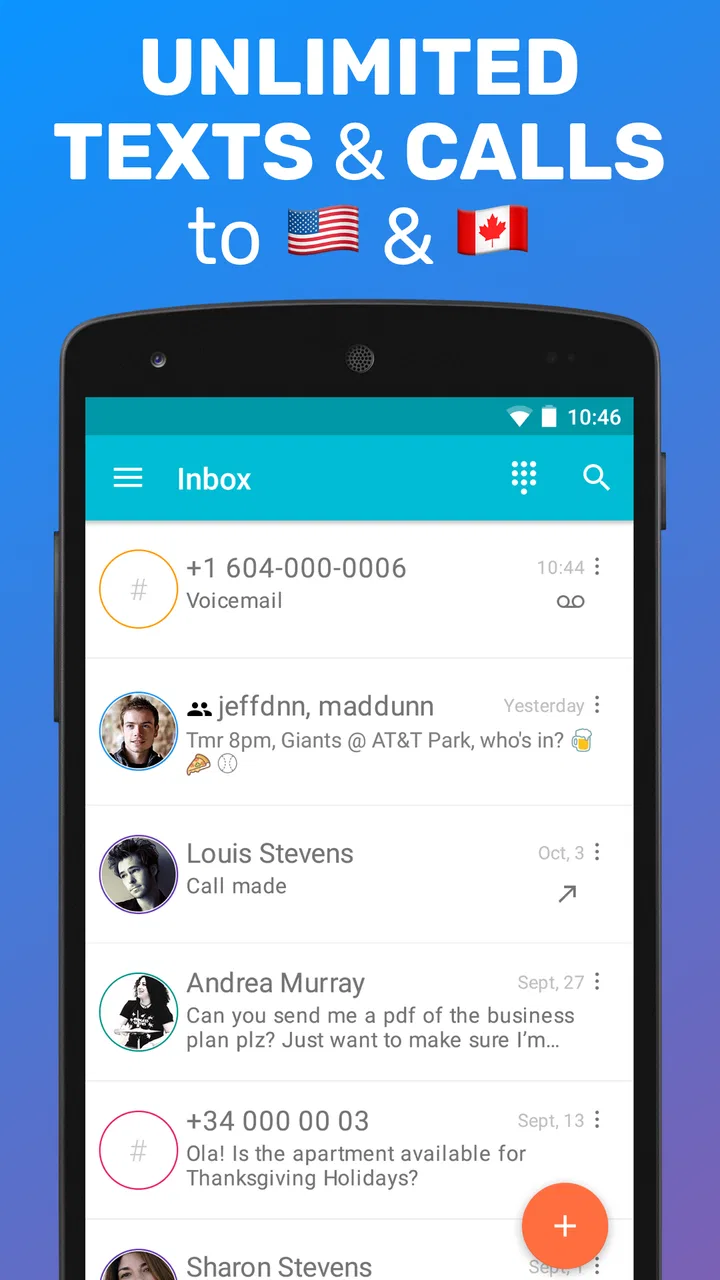
TextMe Up Calling & Texts
- 4.2
- Rating
- 10.00M
- Installs
- Free
- Price

 Analysis by App-foxy
I like communication apps that solve one clear problem without forcing me to change how I use my phone. TextMe Up Calling & Texts takes that approach by giving me a way to text and call from an additional phone number, while also letting me keep multiple numbers in one account. That capability is the reason to consider it, not a long list of decorative extras.
In my experience, the app is most useful when I want separation. I might need a number for a temporary project, online selling, travel planning, or conversations that I do not want mixed into my main personal line. Instead of carrying another phone, I can use this communication app from the same device. It is free to install, rated for Everyone, and developed by TextMe, Inc., so the starting point is easy for most people.
The important distinction is that this is not simply another place to send messages. Its practical value comes from the extra-number setup. A second number can act as a boundary between parts of your life, although it should not automatically be treated as a complete replacement for a traditional mobile line.
You May Also Like

 Blood Strike: 2.5 Anniversary
Blood Strike’s Loadouts Turn Every Drop Into a Tactical Gamble
A close look at Blood Strike’s custom loadouts: how fast access to signature weapons reshapes its battle royale rhythm, rewards preparation, and narrows the gap between fights.

 Pandora - Music & Podcasts
Pandora’s Music Is Easy to Start, but Harder to Recover
Pandora’s strength is its low-effort path from a seed to a station. Its weak spot is how much confidence it asks you to place in connection, setup, and quiet recovery.

 8 Ball Pool
 Is Built on Rivalries, Rematches, and Routine
A close look at the rivalries, rematches, shared routines, and unanswered safety questions that turn a quick pool match into a persistent mobile community.

 Samsung Music
’s Quiet Strength Is Playing What You Already Own
Its reach comes less from spectacle than from dependable access to a personal library. That simplicity is both the app’s strongest retention engine and its ceiling.

 AccuWeather: Weather Radar
AccuWeather Review: A Quick, Clear Forecast for Everyday Decisions
For everyday plans, the best forecast is the one you can understand quickly. AccuWeather makes rain timing, radar, and local conditions easy to act on, with a few trade-offs.

 Hill Climb Racing
Why Hill Climb Racing Still Turns Crashes Into One More Run
A tiny car, a bumpy hill and one more upgrade: Hill Climb Racing keeps resurfacing because its simple chaos makes every near-miss feel personal.
More From Our News Desk



Why the extra-number capability matters
Most people already have a normal phone number, so an app like this has to earn its place by handling a situation the regular dialer handles poorly. TextMe Up does that by putting calling and texting around an additional number in one account. The result is useful for people who want flexibility without buying a second handset.
I see three especially practical uses. The first is privacy in everyday exchanges. If I am listing an item for sale or arranging a service appointment, I may prefer not to publish my personal number. The second is organization: a separate number can keep volunteer work, a side project, or a short-term activity away from family and close friends. The third is convenience when I need more than one identity on the same phone.
That separation is more meaningful than it sounds. When every conversation arrives through one number, it becomes easy to answer a work-related message late at night or lose an important personal text among less urgent threads. A second number does not solve time management by itself, but it gives me a cleaner mental and practical dividing line.
The app’s store summary focuses on texting and calling from a free phone number, plus multiple numbers in one account. I would treat that wording as the central promise and judge the app by how well it supports those tasks. It is not the right choice simply because it has a familiar chat interface; its value depends on whether an additional number genuinely helps your routine.
What using another number changes
A separate number changes what you share with other people. For example, I can give a contact a number connected to a specific purpose rather than exposing the line that follows me everywhere. If that conversation becomes inconvenient, I have not necessarily made my primary number part of the exchange.
There is also a useful psychological effect. A dedicated number makes it easier to recognize why a message is arriving before I respond. That can be valuable for a small side business, a community group, or a short project. I would still keep my expectations realistic: an app-based number is not the same as a second carrier subscription in every situation, and I would not use it for anything where guaranteed carrier-level service is essential.
Multiple numbers in one account can also reduce device clutter. Rather than switching between phones or maintaining separate hardware, I can keep the relevant conversations in one place. The trade-off is that one device now contains more communication streams, so I need a simple naming and checking habit to avoid replying from the wrong number.
How it works in an ordinary routine
The basic workflow is straightforward. I open the app when I want to send a text or place a call through the app’s number rather than the number attached to my mobile service. If I manage more than one number, the key practical step is checking which one is active before starting the conversation. That small pause matters more than it does with a single-number messenger.
For a new contact, I would first decide what the conversation is for, then choose the appropriate number and begin the text or call. For an existing conversation, I would be careful not to assume that the last-used identity is always the one I want. This is one of the non-obvious habits that makes multiple-number apps work well: treat the selected number as part of the message, just as you would check the recipient.
My advice is to establish a naming system immediately. I might think of one number as “personal” and another as “project,” even if the app’s interface presents them in a different way. Keeping those roles consistent reduces accidental mixing. It also makes it easier to decide which conversations deserve a response now and which can wait.
The app is free to download and use as a starting point, but it includes in-app purchases ranging from $0.99 to $79.99 per item. That means I would review any purchase screen carefully before committing. A person who only needs occasional communication should avoid assuming that every useful option is included at no cost. The free entry point is attractive, but the overall value depends on how often you need the service and which extras you choose.
TextMe Up runs on Android 7.0 or later, which makes it accessible on many older devices as well as newer ones. Its current version is 3.55.0. I would still keep the app updated when possible, especially for a communication tool, because calling and messaging depend on reliable day-to-day behavior more than a casual game does.
A realistic example: selling a desk locally
Imagine I am selling a desk through an online marketplace. I want interested buyers to reach me by text, but I do not want my main number attached to a public listing. I can use a separate number for those questions, arrange a pickup time, and keep the conversation distinct from family messages.
The useful part is not only privacy. The separate number gives me a quick filter: when a message arrives there, I know it relates to the sale. I can check it during a planned window instead of letting every inquiry interrupt the rest of my day. If I later stop selling items, that number has served a defined purpose rather than becoming permanently entangled with my personal contacts.
There is a trade-off in this scenario. I need to tell the buyer exactly which number to use, and I need to remember to answer from the same identity. If I accidentally switch numbers, the conversation can become confusing. For a small, temporary exchange, that is manageable. For a high-volume business, I would want a more specialized business phone system with stronger contact management and clearer team controls.
Other situations where it can be useful
A freelancer could use an additional number for an early-stage project while keeping personal calls separate. Someone organizing a local event could share a dedicated contact line with volunteers. A traveler might appreciate having a communication identity that is separate from the number normally used at home, depending on the people and services involved.
I would also consider it for people who want to test a new activity without immediately publishing their primary contact details. That might include tutoring, neighborhood services, or a short-term group. The app is especially convenient when the activity is real but not permanent, because carrying another phone would be excessive.
However, I would not use it as my only critical contact method without first making sure it fits the people I need to reach. Some contacts expect a conventional mobile number, and some organizations may not treat app-based numbers the same way as carrier numbers. The right approach is to test the specific workflow before depending on it for something urgent.
Trade-offs compared with usual alternatives
The usual alternative is a second SIM, an eSIM, or another physical phone. Those options can feel more native because calls and texts may appear alongside the main line in the phone’s standard tools. They can also be better when I need dependable carrier service, broad compatibility, or a number that behaves exactly like a regular mobile line.
TextMe Up is more convenient when I do not want another device or another mobile plan. Keeping multiple numbers in one account is a strong advantage for a person who values portability and simplicity. The compromise is that I am relying on an app-based communication layer, so the experience may not feel as seamless as using the phone’s built-in cellular service.
Another alternative is a mainstream internet messenger. Those services can be excellent for people who already share the same platform with their friends and family, but they usually depend on both sides using the same service. TextMe Up’s phone-number approach is more practical when I need to contact people through ordinary texting or calling habits rather than asking everyone to install the same messenger.
There is also a privacy-focused calling or messaging service to consider. Such apps may offer a different balance of identity protection, account controls, or encryption. I would not assume that TextMe Up is automatically the strongest option in every privacy category. Its clear strength is the convenience of a separate number and multiple-number management, not a universal answer to every security concern.
Price is another point of comparison. A second carrier line usually creates a recurring service commitment, while this app can be tried without an upfront purchase. That makes it appealing for occasional or temporary use. On the other hand, in-app purchases can change the cost calculation, so frequent users should consider their actual habits instead of choosing it only because the install price is free.
Where friction appears
The biggest friction is identity management. With one number, I rarely need to think about which line I am using. With multiple numbers, I do. A rushed reply can come from the wrong number, and a missed call can be harder to interpret if I have not built a consistent routine.
Notifications can also become more demanding when several communication roles share one phone. I would decide which conversations deserve immediate attention and avoid treating every new message as equally urgent. The app can separate numbers, but I still have to create the personal rules that make that separation useful.
I would also be cautious about using the service for account recovery or other situations where a number may need to remain available for a long time. A temporary communication number is excellent for a temporary purpose, but it is not automatically the best foundation for an important account that I cannot risk losing access to. For those cases, I prefer a stable number that I control through a long-term mobile service.
Calling quality and message delivery are the kinds of things I would judge in my own environment rather than assume from the app’s description. Wi-Fi strength, mobile data, device age, and the recipient’s network can all affect an internet-based communication experience. I would make a short test call and send a test message before giving the number to a large group or relying on it for an appointment.
Who will get the most from it
TextMe Up is a good fit for someone who needs a practical second number without carrying a second phone. It suits people with temporary projects, casual selling activity, community responsibilities, or a clear desire to separate personal conversations from another part of life. The multiple-number setup is particularly useful when one device needs to support several roles.
It is also approachable for people who do not want to commit to another carrier plan immediately. The free price makes experimentation easy, while the Everyone age rating keeps the app broadly accessible from a content perspective. Its strong adoption is reflected in an average rating of 4.2 from around 90 thousand ratings, with over 10 million installs, so it is not an obscure experiment with no established audience.
Still, I would skip it if I need a guaranteed replacement for my primary mobile line, advanced business administration, or a service designed around a large team. I would also choose a regular carrier line if my priority were maximum compatibility with every organization, automated system, or emergency-dependent situation.
For a person who mainly chats with friends already using one shared messenger, this app may add unnecessary complexity. The extra-number advantage matters only when the number itself solves a problem. If all your contacts already reach you comfortably through your existing phone service, there may be little reason to introduce another communication channel.
My practical setup advice
I would begin with one clearly defined purpose rather than immediately trying to manage every possible use. Give the number to a small group, test both texting and calling, and observe whether the separation actually makes your day easier. If it does, then consider whether another number has a distinct role or would simply create more notifications.
I would keep a note of which number is used for which purpose, especially during the first week. Before each new message or call, I would check the active identity. I would also review purchase prompts with care, because occasional users and heavy users may reach very different conclusions about the app’s value once in-app purchases are involved.
Finally, I would tell important contacts how to reach me and avoid presenting the extra number as interchangeable with my permanent mobile identity. That honest framing prevents confusion. The app works best when I use it as a deliberate communication layer, not when I expect it to erase every difference between an app-based number and a carrier-provided line.
After using it with that mindset, I see TextMe Up Calling & Texts as a focused and useful communication app rather than an all-purpose phone replacement. Its best idea is simple: let me create distance between parts of my life while keeping the convenience of one device. If you need a separate number for a defined purpose, this is where the app earns its place.
My recommendation is strongest for temporary projects, privacy-conscious everyday exchanges, and people who want multiple numbers without buying more hardware. I would be more cautious for long-term essential communication, demanding business workflows, or situations where a traditional carrier line is the safer choice. Used within those limits, the app offers a practical balance of accessibility and flexibility, with enough room to test the idea before deciding whether it belongs in your regular routine.
FAQs for TextMe Up Calling & Texts
01What is TextMe Up Calling & Texts, and what can I use it for?
TextMe Up Calling & Texts is a communication app that provides calling and messaging features through an internet connection. After installing it, users can generally use it to send text messages, make voice calls, and manage conversations from a dedicated phone number. It can be useful for staying in touch without relying entirely on a traditional mobile plan, although available features may vary by country and device.
02Does TextMe Up require Wi-Fi or mobile data to work?
Yes. TextMe Up relies on an internet connection for its calling and messaging services, so you normally need Wi-Fi or mobile data to communicate. Call quality and message delivery can be affected by weak connectivity, network congestion, or background data restrictions. If you use mobile data frequently, it is worth checking your carrier plan, because voice calls and media messages may contribute to your data usage.
03Can I get a phone number with TextMe Up?
TextMe Up may allow eligible users to select or obtain a phone number for calling and texting, depending on their location and the current options offered in the app. Number availability, area codes, verification requirements, and calling destinations can differ by region. Before depending on the number for important accounts, confirm whether the service supports the type of verification or recovery messages you need.
04Is TextMe Up Calling & Texts free to use?
The app may offer free communication options, but not every feature is necessarily free. Certain calls, international destinations, premium numbers, number-related services, or ad-free functionality may require credits, subscriptions, or in-app purchases. Pricing and included allowances can change, so review the current in-app rates and subscription terms before making frequent calls or committing to a paid plan.
05Is TextMe Up safe and suitable for private conversations?
TextMe Up includes standard account and communication features, but users should avoid assuming that ordinary app messages or calls provide the same protection as a dedicated end-to-end encrypted messenger. Review the app’s privacy policy, permissions, and account-security settings before use. Avoid sharing highly sensitive information, protect your login details, and remember that internet-based communications can still involve service-provider data handling.
Pros
- Offers a separate number for calling and texting.
- Works over Wi‑Fi or mobile data
- helping reduce carrier charges.
- Supports international calls and messages in many destinations.
- Includes voicemail and call-management features.
- Available on both Android and iOS devices.
Cons
- Free calling and texting may require watching ads or earning credits.
- Some international destinations can be expensive without a paid plan.
- A reliable internet connection is required for good call quality.
- The app may request access to contacts and other device permissions.
- Your number or account may depend on continued app and service support.

TextMe Up Calling & Texts
Gallery